
Refuse the Seduction: Cultural Violence

What is the big deal?
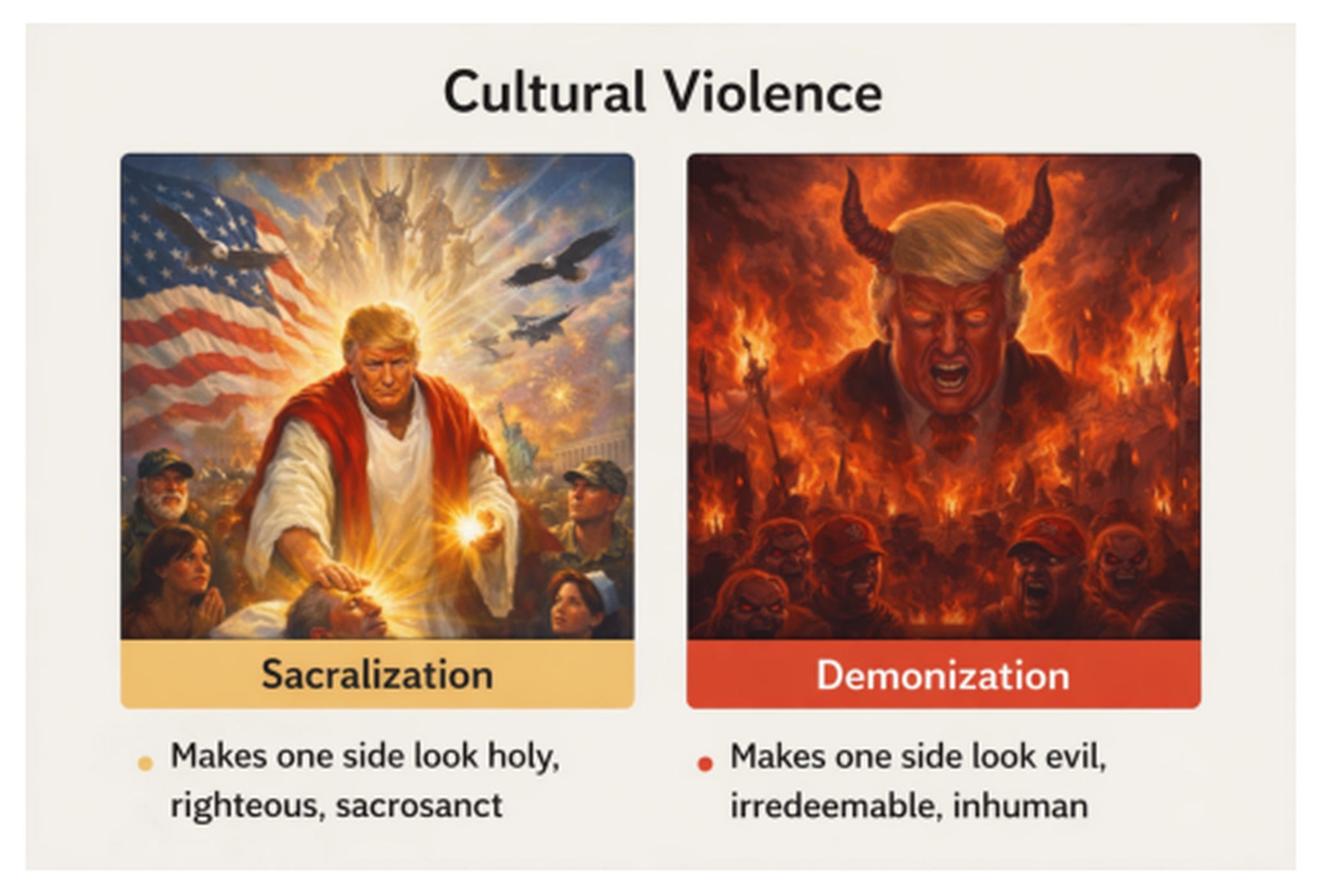
That’s a fair question. The image on the left, the one Trump posted on Truth Social and later took down, portrays him in a Christ-like way. Halo-like light, healing the sick, combined with the American flag. Essentially, it says that Trump is God.
That is the big deal.
Peace scholar Johan Galtung (1990) describes cultural violence as “any aspect of a culture that can be used to legitimize violence in its direct or structural form” (Galtung 1990, p.292). So cultural violence shapes who we see as sacred or threatening, and whose suffering we learn to find acceptable. It doesn’t look like physical harm, which is part of what makes it so effective. Violence doesn’t have to leave a bruise or cause blood to be violence. Cultural violence works through the visual, the aesthetic, the emotional. It forms us before we’ve had a chance to think.
The image Trump posted didn’t directly hurt anyone. But such an image works on us to help us distinguish who is us and who is them. It potentially and stealthily arranges our thinking so that cruelty, exclusion, or unquestioning loyalty feels morally right. Who is going to disagree with God? If you disagree with or critique God, that is a moral failure! We are much more likely to let physical violence happen to people who disagree with God.
Something Galtung also taught me—the threat of violence is also violence.
So, perhaps against my better judgment, I asked ChatGPT to create an inverse image: Trump as the Devil. Perhaps that is a sign of my own moral failure. So, I ask forgiveness now. Both images make my stomach hurt.
I don’t believe Trump is the Devil. That’s not the point. The point is that the Devil image works the same way as the Jesus image. In the Devil image, Trump is portrayed as evil. It encourages me to consider Trump as the Devil, and thus, anyone who associates with him is also evil. I am much more likely to let violence happen to evil people. That is cultural violence!
The Jesus and Devil images are good examples of flattening a human being into a category. And both flatten the people around Trump as well, the supporters, the critics, everyone pulled into the gravitational field of the symbol. The Jesus-and-Devil images do not allow for complexity in our relationship to Donald Trump and his policies. They make it easier to move toward a dehumanization that can look like adoration on one side and disgust on the other, and neither side tends to recognize what it’s doing.
Images are never just images. They shape what we believe is justified before we ever act.
The work of peace begins in the willingness to notice what our images are doing to us, and to refuse the seduction of both the halo and the horns.